May 19, 2015

Sugru: Duct Tape meets Playdough!

Can there be something as fun and creative as Playdough and as practical as duct tape? As a ham always looking for cool new things, I think so! It's called Sugru.

It's a new material which looks and feels like Playdough in your fingers. It comes in variety of vibrant colors and can be molded into a million different shapes. But it's after you shape it that the magic begins. simply let is sit for 24 hours to "cure" and it turns into a firm, almost rigid form of rubber. It will adhere to most surfaces and is waterproof and durable.

My first experience with Sugru came after my son dropped his table computer and splintered off a small piece of rubberize plastic trim around the edge. With a pea-sized ball of Sugru, pressed into the hole where missing piece had been, his tablet was as good as new and it was almost impossible to see the repair.

I used large marble-sized ball to create a mic holder for my FT-100D. It's looks good and works well. The Sugru website has hundreds of creative ideas of how to use the interesting stuff. There are a couple of downsides.


Once you open the Sugru package, it starts curing, which means you have to use it or loose it. for that reason, they sell it in small, single-use packets (about the size of a bite-size miniature candy bar). And it's not the cheapest fix. It comes in a pack of three for $12 or eight for $22.


Intruder Alert! Who's on the band?

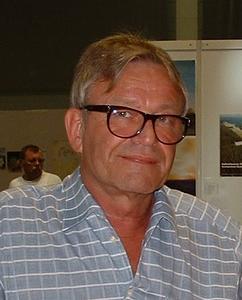
Wolfgang Hadel, DK2OM
If you've spent any time at all cruising through the HF bands, you've likely come across an out-of-place signal or two. Perhaps it was an voice in the middle of the 20-meter CW sub-band or music playing at the top of 15 meters. Perhaps it was a strange data signal that sounded like RTTY but just kept repeating itself over and over again. "Where is that coming from?" you thought.

If you're Wolfgang Hadel, it's just another day on the hunt. Wolf, better known as DK2OM, spends a good portion of his time listening for rogue signal in the ham bands and trying to figure out who it behind them. He co-ordinates the International Amateur Radio Union's Monitoring System in Region 1 (Europe, Africa, Middle-East and Northern Asia). Each month Wolf compiles a newsletter highlighting what he has found and it can be very interesting reading to say the least.

Each report is filled with a spreadsheet of signals heard and their possible sources. There is also some graphs which show just have much of the bands some signal cover.

Wolf often forwards information on the worst offenders to governmental authorities who in turn can file formal complaints. In one recent case, and intruding signal even interfered with emergency traffic originating out of Napal, which is recovering from the effects of a massive earthquake.

Here is a copy of the most recent monthly report.
There is shorter version with the most recent updates available here.
Visit the monitoring system's website for more information.

May 08, 2015

Fun Stuff from the ARRL's Contest Guy

I've never scored very well in a contest, but I do appreciate the ARRL's regular "Contest Update." It goes well beyond the normal list of events and where to find contest rules. In fact, Ward Silver, NØAX, goes out of his way to compile a TON of interesting tidbits of information that appeals to more than typical contester.

Here's a some of this week's update I thought was interesting:

------------------------
TECHNICAL TOPICS AND INFORMATION

Measuring RF power/signal strength accurately is a non-trivial undertaking. Mike N8MSA strongly recommends this Keysight (nee Agilent nee Hewlett-Packard) tutorial or this older, more detailed treatment. Both cover the complexity caused by different modulation types, bandwidths, onset rise-time and numerous other factors.

A sky full of CubeSats? There will be if Planet Labs gets enough funding to fulfill its dream of taking one full-Earth snapshot every day! (Thanks, John WV8H)

Repurposing champ, Charlie NØTT found a great method of cable control. "I use plastic guttering from the local home center for use as a wiring/cable tray. I homebrewed some brackets to attach it to the back of my desk then cut access holes I wanted with a hole saw/drill."Every time we turn around there is a new technique to do something in your own lab which previously required special machines and techniques. Here's an EE Times story about alternative ways to do your own PCB fabrication.

Brian N9ADG found a one-dollar add-on clip to fix that RJ-45 connector with the broken-off tab that allows your microphone to fall out of the rig and under the passenger seat where you can't reach it and have to pull all the way over to the shoulder to get it and then you can't merge back on to the highway and wind up late! Wait, what was I talking about?

Technical Websites of the Week - Glenn WØGJ spotted this article about disturbances in the upper atmosphere resulting from the recent earthquake in Nepal. Does this imply a mechanism for short-term propagation caused by quakes? On the Sun, nano-flares can stir things up and add heat to the corona - like it needs to be any hotter - resulting in changes in our upper atmosphere, too. Elsewhere, the Daily Mail takes the pulse of Ol' Sol with an article about two-year cycles inside the Sun driving big solar storms. Big cycles, little cycles - as long as they make sunspots, who cares?
--------------------------

If you're an ARRL member and would like to receive the ARRL Contest Update yourself, you can sign up here.

May 02, 2015

New Section Manager for ARRL's NTX

Nancy McCain, K5NLM
The ARRL North Texas Section has a new Section Manager. Nancy McCain, K5NLM, from Fort Worth, formally took over the position on May 1, succeeding incumbent SM Chris Brewer, N5GMJ. Brewer resigned due to increased work and family commitments.

ARRL Field Services and Radiosport Manager Dave Patton, NN1N, made the appointment in consultation with Brewer (who recommended McCain for the post) and ARRL West Gulf Division Director Dr David Woolweaver, K5RAV. Brewer, of Saginaw, has served as the North Texas Section Manager since April 30, 2013.

McCain, who is presently a North Texas Assistant Section Manager, has been active in ARES, RACES, and in Army and Navy MARS. She is a retired emergency management specialist. She will complete the current term of office as North Texas Section Manager, which runs until March 31, 2017.

Here's the full story on the ARRL's website.

April 28, 2015

N9JN talks up Emergency radio in E.TX

John Newman, N9JN, visited the Rusk County Amateur Radio Club during its recent April meeting to talk about emergency communications in East Texas. John is a director of the East Texas Emergency Communications Services club in Tyler. He also works with the state-wide RACES group. John spoke about the organizations efforts to serve numerous agencies in the region during local disasters.

John also brought Gene Coldwell, WB5CTQ, and Mark Taylor, W5MCT, with him to talk about digital communications and training opportunities. All three amateurs have used amateur radio to provide assistance to local cities, counties, non-profit groups and even the state of Texas.

Mark also gave a brief demonstration of Fldigi, even receiving a form on an android tablet.

April 25, 2015

Tropo opening brings in 2-meter DX

By KN5G - There was a nice tropo opening (Tropospheric Propagation) Saturday morning around 10:15 a.m.  I managed to work three stations on 2 meter single sideband, to the Southwest. The farthest station, XE2OR, was down in Mexico!

April 17, 2015

Club shows off at Electric Co-op Expo

Craig (AF5RI) and David (W5CWT)
man the RCARC booth
at the  2015 RCEC Expo
Members of the RCARC were on hand at the Rusk County Electric Cooperative's (RCEC) annual expo, Thursday, April 9th. Club members showed off a little 20-meter activity, thanks to Richard's (K5RRB) coax and antenna. The RCEC holds a special place in local hams' hearts, since it hosts the club's repeater antenna on the co-op's 400-foot communications tower, just northeast of Henderson.

It is the second year the club has been on hand for the farm and ranch expo. The club participates in the emergency services and health and well-being section of the event, demonstrating the role of Amateur Radio in times of emergencies.

And as fate would have it, that role came in handy as a series of storms rolled into the area prompting an early end to the expo. Several local hams broke-down the booth and then headed out to spot storms. By the end of the evening three separate areas of rotation and at least one wall cloud were spotted by members of the SKYWARN net.

April 01, 2015

Featured Shack: K-Zed-5-Sugar! (Ken)

Ken's "Sugar-Sweet" Shack
This month, Ken, better known as "K-Zed-Five-Sugar," opens his shack to reveal the mysteries inside. Along the way, he tells how he got started in ham radio and became KZ5S, although didn't start with such a "sweet" callsign.

In fact, he took a break from it all and pursued a long career in the telephone industry where he was president of a contracting company with more than 500 people pulling telephone cable across the state of Florida.

Ken picks up the story...

"I got Interested In Radio Back in 1955 Living In Orlando Fl when some one gave me a CB HT, I heard some one on that radio and after many days of playing with it I talked to him and from there I went into CB big time. In 1976 I took my first ham test as Novice (WD4DDP) one month later I took my Technician test, and one month later In Tampa Fl at the FCC office I took my General test at 13 words a minute code (N4ALP )."

"My first Ham radio was a Yeasu FT 101 EE, down the road I got a Kenwood TS 130 S." "I enjoyed the radio but in 1984 my work took me away from my hobby. In 2005 I took my extra class, I got my Call (KZ5S) have been hooked on ham since. I joined the Amateur Club in Jacksonville TX and served as president for one term, and when I heard about the ham's in Henderson setting up a Club I jumped in where there is a great bunch of people."

 Here's a look at Ken's station...

Ken, KZ5S
"On the top shelf is a jetstream 75 amp power supply with a purple onion for good luck. On the next shelf down is my computer windows 7, an MFJ 962 D Versa Tuner 111, a Swan wm-3000 watt meter and an MFJ 4726 antenna switch. On the lower shelf left to right is a FT 2800 FM 2 meter set up, a Kenwood 25 amp power supply and an MFJ 993 Automatic Antenna Tuner."

"Under that is the IC 718 Transceiver. Next to it is an IC 125 power supply. On top is my Signalink USB and an IC 746 Pro Transceiver. On top is ten-tec code keyer and last is the lamp made from a D104 MIC. And just out of site is my AL-811 H amp. 73 De KZ5S"

March 07, 2015

NBEMS connects Hams in Emergencies

Software for emergencies
Emergencies breed chaos. Planning helps to minimize it. Let's face it, chaos and confusion will always be a part of emergencies, but knowing what tools to will use and being familiar with how they work can go along way to reducing the stress and urgency of responding to sudden situations. Recently, at a club meeting, I was giving a brief overview of how we might respond in an upcoming emergency drill. One of the hams in the room admitted, my overview when right over his head. I'm certain he wasn't alone. Now is the best time to learn.

So when an emergency happens, what tools will you use? Part of the joy of ham radio is the fact that it is such a varied and diverse hobby. There are dozens of modes, hundreds of radios, and an infinite number of frequencies to use. How will anyone ever communicate with anyone else?  That's where NBEMS steps in.

The Narrow Band Emergency Messaging System (or NBEMS) is a suite of software that connects hams in emergency situations. It provides a single set of programs and operating concepts that can unify a group of hams. NBEMS is based upon the idea of keeping the things cheap, using simple,

March 02, 2015

Winlink Packet Gateway Up at OEM

A new packet station is up and running at the Rusk County Office of Emergency Management, providing a Winlink gateway for local amateurs. The station is designated as W5CWT-10 and can be reached on 145.07 MHz.

The station is using the OEM's Icom V8000 radio at about 70 watts, connected to a large onmi-directional antenna above the building. KN5G was able to work the station from a little less than six miles away. Additional reports would be helpful in determining actual coverage area.

Although the station can be used as a digipeater, its primary function is to provide a local packet gateway to the Winlink system. Winlink is a volunteer-supported network of email servers located around the world. Access to the servers is provided by thousands of VHF and HF "gateway" stations.

HF gateways typically use the "Pactor" protocol or a similar open-source protocol called "Winmor." VHF station generally use packet the protocol. Radio amateurs can log into the system via a gateway and send or receive email messages, including ones to or from regular, non-amateur radio internet users.

To use the system, an amateur needs a radio, a computer and an interface to connect the two. In the past, a physical "TNC" or radio modem was required to act as an interface between the user's radio